July 2026 edition summary
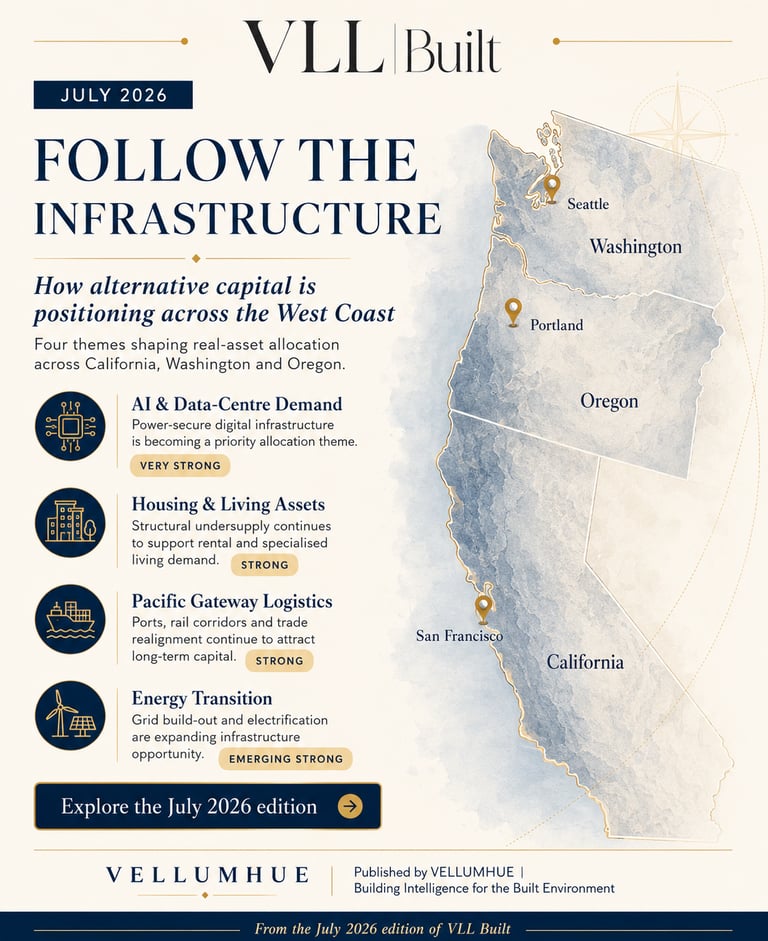
The July 2026 edition of VLL Built explores alternative investment across the U.S. West Coast, focusing on California, Washington and Oregon. Its central argument is that the region remains one of America’s most investable built environments because innovation, population movement, housing pressure, global trade and infrastructure demand continue to reshape long-term value.
California is presented as the region’s market of scale, capital depth and global connectivity, with opportunities across urban regeneration, logistics, data centres, living assets and clean energy. Washington stands out for its technology and cloud ecosystem, aerospace, Pacific trade gateways and renewable-power advantages. Oregon offers a more measured growth story built around advanced manufacturing, industrial capacity, housing demand, livability and sustainable infrastructure.
The edition then examines the investment sectors connecting all three states:
Digital infrastructure, driven by AI, cloud adoption, connectivity and power demand
Living assets, including rental housing, student living, senior housing and hospitality
Logistics and industrial assets, supported by ports, freight corridors, e-commerce and supply-chain realignment
Energy and infrastructure, shaped by electrification, grid expansion and decarbonisation
The closing investment playbook stresses disciplined market and sector selection, durable income, realistic capital planning, strong operations, reliable power and connectivity, ESG integration and clear exit optionality. It also highlights risks involving interest rates, construction costs, planning, utility constraints and execution.